

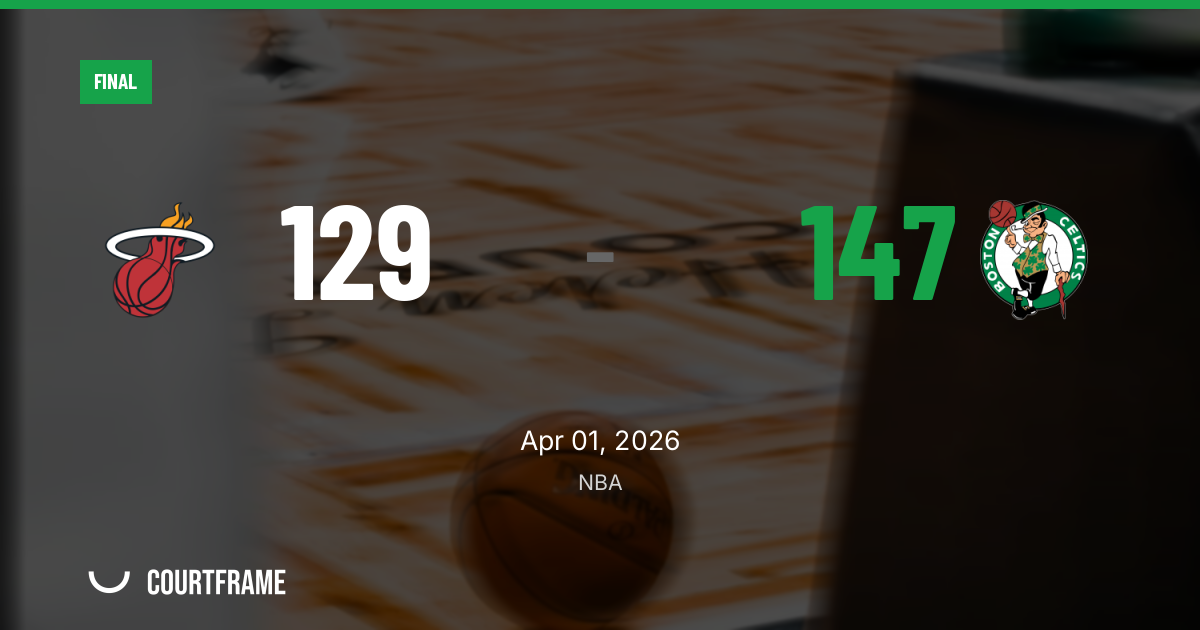
BOSTON — The Celtics didn’t ease into April. They detonated it.
Boston dropped 53 points in the first quarter and rode that early avalanche to a 147-129 win over the Miami Heat on April 1, 2026, at Kaseya Center. The result pushed the Celtics’ momentum forward off a strong recent run (WLWWW) and left Miami (40-37, LWLLW) chasing answers after allowing one of the biggest opening punches you’ll see all season.
Game flow: Boston’s first-quarter eruption set the terms
The entire night tilted in the opening 12 minutes. Boston’s 53-point first quarter wasn’t just a hot start — it was a structural advantage that shaped every possession afterward. Miami managed 33 in the same frame, but the Heat were instantly forced into a higher-variance style: faster pace, quicker shots, and constant pressure to trade baskets.
Boston followed the initial surge with a steadier second quarter (27 points) to keep control at halftime, then answered Miami’s best stretch after the break. The Heat erupted for 45 in the third quarter, their biggest period of the game, but Boston still put up 32 in response — the key detail that prevented the comeback from ever truly arriving. When the Celtics posted 35 more in the fourth, the margin held and the outcome stayed out of reach.
Turning point: Miami’s third-quarter push didn’t flip the math
If there was a window, it was the third. Miami’s 45-point quarter was the kind of offensive burst that typically swings a game at home. But Boston’s ability to keep scoring — 32 in the same period — blunted the impact. The Heat needed a defensive turn to pair with that offense. It never came.
How Boston won: passing, pace, and sustained shot creation
The Celtics finished with 34 assists, a clean indicator of how they generated offense: quick decisions, advantage creation, and consistent ball movement that kept Miami rotating. In a game that reached 147 points without overtime, that level of assisted offense matters — it’s how a team maintains efficiency even as the opponent inevitably makes a run.
Miami logged 27 assists, but the Heat were playing from behind from the opening minutes, which often compresses playmaking into tougher, more urgent possessions. Boston, by contrast, controlled the rhythm early and could keep hunting the best look rather than the fastest one.
What it means going forward
Celtics
At 51-25, Boston continues to look like a team built to travel in the postseason: explosive scoring capability paired with a pass-heavy attack that translates across environments. The first-quarter barrage was extreme, but the more repeatable signal was the assist total — a marker of offensive connectivity that tends to hold up when defenses tighten.
Heat
Miami’s 40-37 record reflects a team still fighting for position, and this one hurt because the third-quarter response showed the Heat can generate enough offense to challenge elite opponents. The problem was the opening defense and the inability to string together stops when the game demanded it most. When you concede 53 in a quarter, every later surge becomes a requirement — not an advantage.