
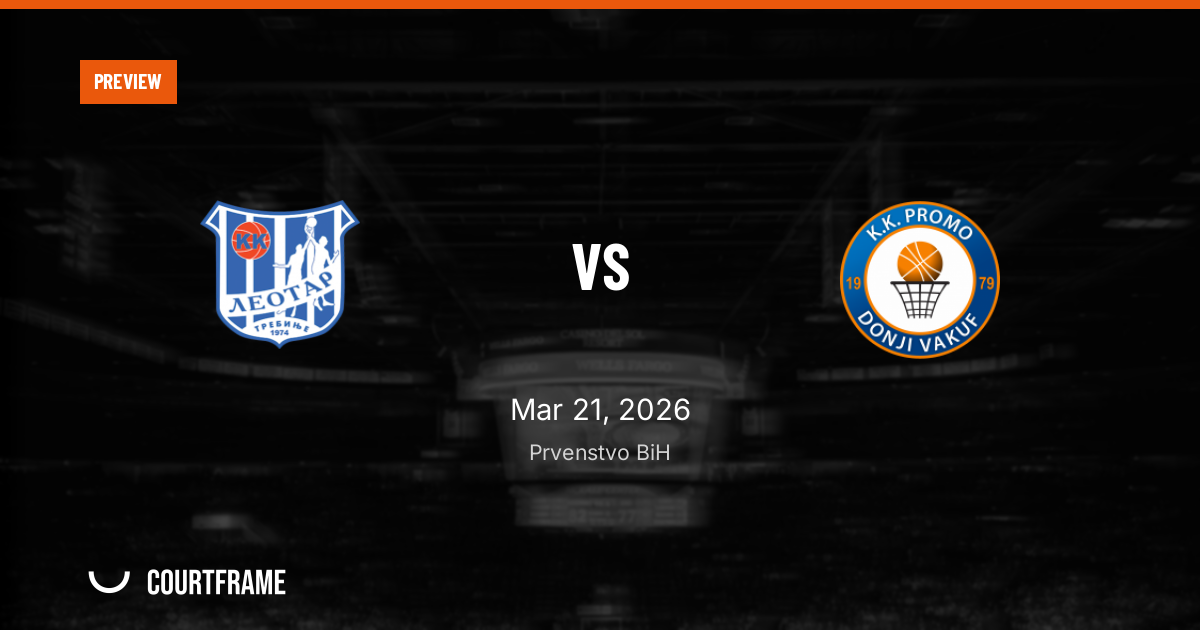
Game context
In the 2025-2026 Prvenstvo BiH season, Leotar Trebinje (8-12) hosts Donji Vakuf - Promo (7-13) on March 21, 2026 at Sportska dvorana Milos Mrdic. The standings pressure is implicit: both teams sit in the same performance neighborhood, so the marginal value of a win is amplified compared to matchups against clear top- or bottom-tier opponents.
Recent form: momentum vs. fragility
Leotar enters on a five-game skid (LLLLL), a pattern that typically signals either structural problems (shot quality, turnover control, defensive breakdowns) or situational variance compounding over a short sample. Donji Vakuf - Promo’s last five (WLLLL) suggests a team capable of finding a winning script, but not one that has stabilized it.
Form snapshot
| Team | Record | Last 5 | Venue |
|---|---|---|---|
| Leotar Trebinje | 8-12 | LLLLL | Home (Sportska dvorana Milos Mrdic) |
| Donji Vakuf - Promo | 7-13 | WLLLL | Away |
Matchup thesis: a “one-possession economy” game
With both teams below .500 and separated by a single win, the most plausible game shape is one where each possession carries outsized value—what we can frame as a one-possession economy. In these environments, outcomes tend to be decided less by highlight runs and more by repeatable edges: defensive rebounding to finish stops, avoiding live-ball turnovers, and generating attempts at the rim rather than settling early.
Custom metric: Swing Game Index (SGI)
To quantify how “standings-relevant” this matchup is, CourtFrame uses a simple, context-only heuristic:
SGI = 1 / (1 + |Home Wins − Away Wins|)
- Leotar wins: 8
- Donji Vakuf - Promo wins: 7
- |8 − 7| = 1 → SGI = 1 / (1 + 1) = 0.50
Interpretation: a mid-to-high leverage regular-season game. When teams are this close, the win has higher expected value in the standings race than a win over a team several games away in either direction.
What to watch
1) Leotar’s first-quarter clarity
A five-game losing streak often correlates with shaky starts or difficulty responding to the first tactical adjustment. At home, Leotar’s priority is to establish a clean offensive identity early—shots they can reliably reproduce possession-to-possession. If Leotar can convert the home environment into composure rather than urgency, the probability of playing from in front rises sharply.
2) Donji Vakuf - Promo’s ability to travel its “winning formula”
Donji Vakuf - Promo’s WLLLL form line implies their success has been intermittent. The key question is whether their win was driven by sustainable process or a one-night spike. On the road in Trebinje, the team that can reduce variance—limiting empty possessions and avoiding foul-driven disruptions—typically keeps its win probability alive deep into the fourth.
3) Late-game execution under equal pressure
This is the type of matchup where both benches feel the weight of every outcome. Expect shorter leashes, conservative decision-making, and a premium on “clean possessions” in the final minutes. If the game is close late, the team that best manages clock, spacing, and shot selection—without gifting transition chances—should own the highest-probability path to a finish.
Expected game script
Given the near-identical records and uneven recent form, the most likely script is a tightly contested game where neither side can rely on momentum alone. Leotar’s home setting provides a natural stabilizer, but Donji Vakuf - Promo’s proximity in the standings suggests they’ll treat this as a direct opportunity to flip the table. The team that plays the more repeatable brand of basketball—minimizing self-inflicted errors—should emerge with the higher expected value outcome.
Bottom line
Leotar vs. Donji Vakuf - Promo isn’t just a mid-table date on the calendar; it’s a leverage point. With both teams sitting at 8-12 and 7-13, respectively, the winner gains more than a single result—it gains breathing room, while the loser absorbs a standings and confidence hit that can linger beyond one night.