

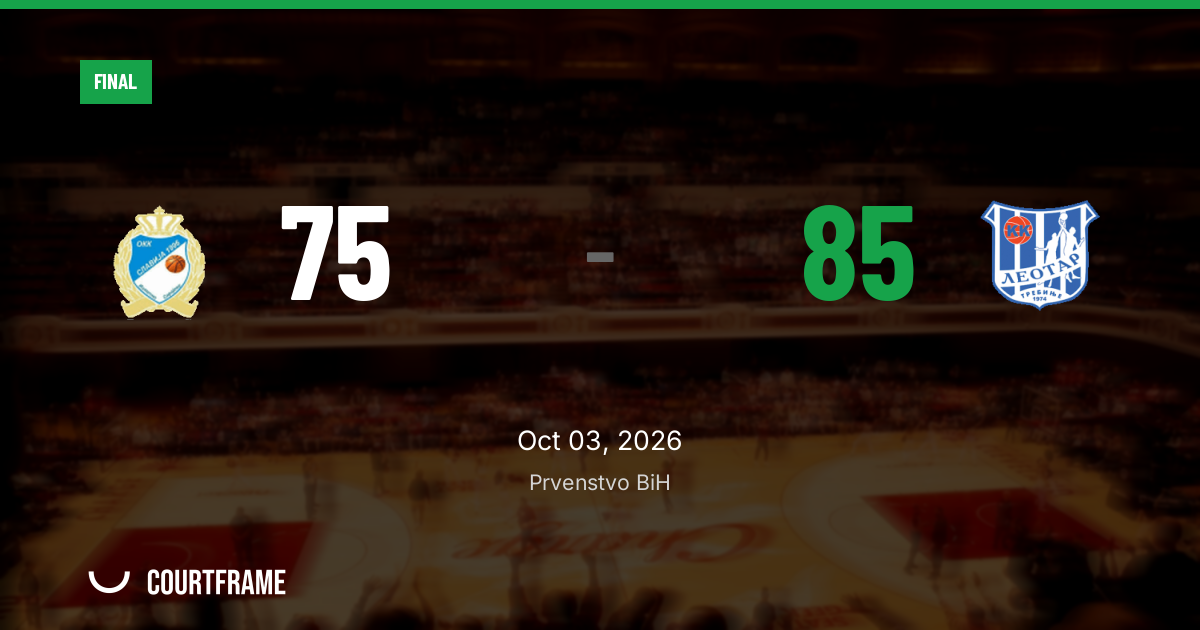
Leotar Trebinje did not need a late surge. It built the game early, absorbed Slavija’s resistance and left Sportska dvorana Slavija with an 85-75 win on October 3, 2026.
The victory gives Leotar a 2-0 lead in the best-of-seven Round 1 series, a result that tracked closely with the pre-game profile. Leotar entered with the stronger CPI position, ranked third with an 81.62 mark, while Slavija came in 12th at 18.38. That gap showed up most clearly in shot-making and ball movement.
Leotar opened with 27 points in the first quarter and followed with 26 more in the second, taking control before halftime. Slavija stayed competitive offensively, scoring 44 first-half points, but could not match Leotar’s efficiency or creation over the full game.
Leotar’s offense set the terms
The defining edge was precision. Leotar shot 13-for-20 from the field and 5-for-8 from three-point range, producing the type of efficient scoring profile that had already appeared in its early-season indicators. Entering the game, Leotar carried a 65 percent field-goal mark, a 62.5 percent three-point percentage and a 226.5 offensive rating through one analyzed game.
That shooting pressure forced Slavija to defend in rotation and opened the floor for Leotar’s passing. The visitors finished with 18 assists, doubling Slavija’s total of 9. That assist gap mattered as much as the shooting itself: Leotar generated cleaner looks, moved the ball with purpose and avoided long stretches of stagnant half-court offense.
Bojanic Vuk and O. Petronijevic entered as the key offensive drivers for Leotar, with Bojanic averaging 23 points, 7 rebounds and 3 assists, and Petronijevic averaging 17 points, 4 assists and 3 rebounds. The team-level numbers reflected that same structure: Leotar’s offense was built around efficient finishing and connected possessions.
Slavija won the glass, but not the shot-quality battle
Slavija had advantages in areas that usually keep a home team alive. It outrebounded Leotar 15-11 and generated 9 steals to Leotar’s 6. K. Kangu entered as Slavija’s leading producer at 18 points and 6 rebounds per game, while P. Sanders provided the main playmaking profile at 10 points and 5 assists.
But Slavija’s offensive math was harder. The home side shot 12-for-24 from the field and 5-for-15 from three-point range. The volume from deep aligned with its pre-game three-point rate of 62.5, but the accuracy gap was decisive. Leotar matched Slavija’s made threes on nearly half the attempts.
Slavija also entered with a turnover rate of 32.1, and while the final turnover count was close — 14 for Leotar, 13 for Slavija — the broader issue was conversion. Slavija created disruption defensively, but Leotar’s half-court efficiency and passing structure reduced the damage.
First-half separation decided the game
The quarter-by-quarter flow told the story. Leotar won the first quarter 27-20 and the second 26-24, building enough of a cushion to withstand a slower second half. Slavija held Leotar to 18 points in the third and 14 in the fourth, but the comeback never fully materialized because the home offense also cooled, scoring 16 and 15 in the final two quarters.
That made the opening 20 minutes decisive. Leotar’s early shot-making created a game state Slavija had to chase, and the home team never found enough sustained creation to flip the pressure.
No injury excuse, no fatigue factor
Both teams entered without significant injuries reported, and fatigue was not a meaningful variable. Each side had 168 days of rest and no games in the previous seven days. This was a clean matchup, and the result reflected the pre-game indicators more than circumstance.
Leotar came in averaging 85 points and left with exactly 85. Slavija came in averaging 75 and finished with 75. In a small-sample early-season environment, that symmetry is striking: the matchup played almost directly to profile.
What it means
Leotar now controls the series at 2-0. The visitors have paired elite early efficiency with enough defensive resistance to keep Slavija from turning hustle plays into a full momentum swing.
For Slavija, the path back is clear but narrow. The rebounding and defensive activity are real positives, but the offensive creation gap is glaring. Unless Slavija can turn its pressure into easier scoring chances and narrow the assist disparity, Leotar’s shot-making and structure will remain the defining forces in the series.